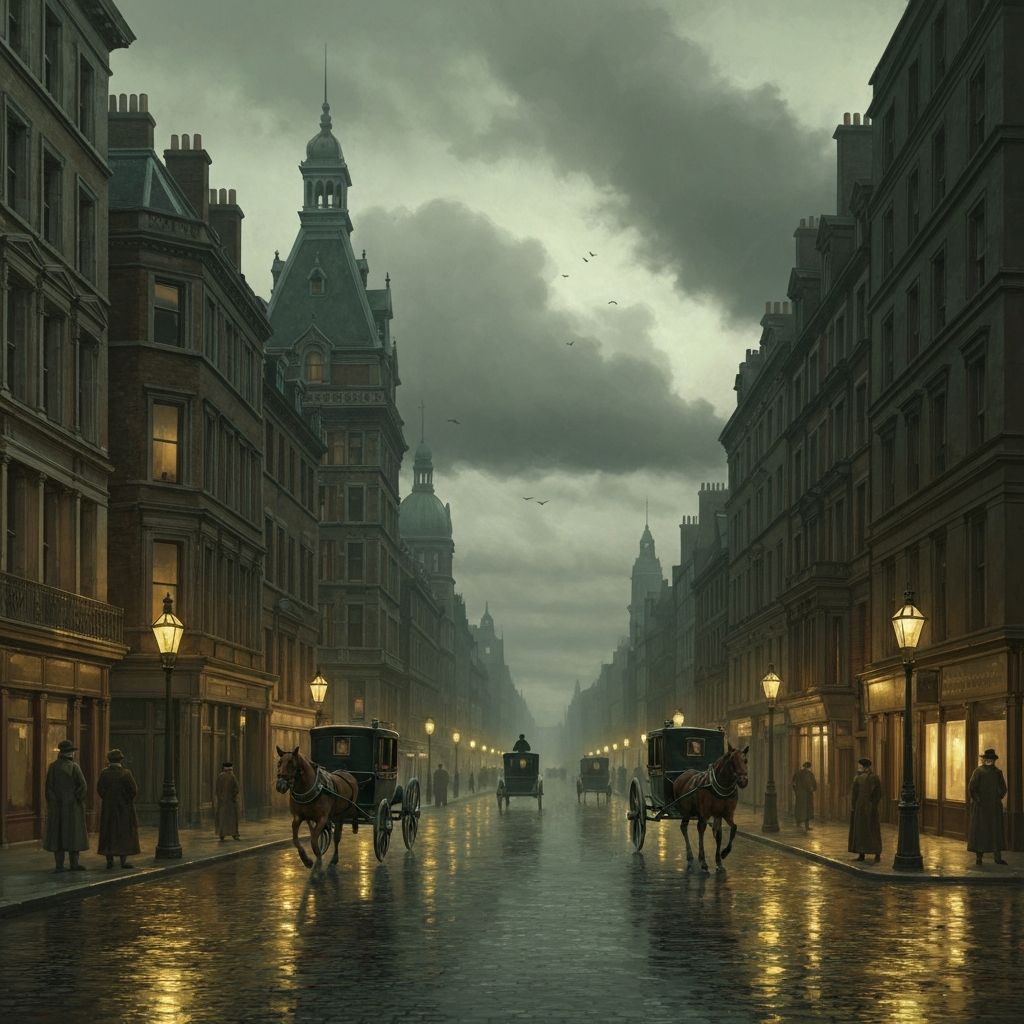
1880–1910: Late Victorian & Edwardian
Final decades of Victoria's reign through Edward VII's. Industrial peak, imperial expansion, rigid class structures, moral codes, gradual social change, and the “long peace” before WWI.
Upper Class / Aristocracy
- Landowners, inherited wealth, political power
- Large estates with armies of servants
- Leisure-focused: balls, hunting parties, “the Season” in London
- Strict codes of behaviour, propriety, decorum
- Marriages arranged for financial/social advantage
Middle Class (expanding)
- Professionals, merchants, industrialists
- Valued respectability, education, hard work
- Aspired to upper-class status
- Focused on self-improvement, moral virtue
Working Class
- Unskilled labourers, factory workers, domestic servants
- Harsh conditions: 12–16 hour days, low wages, no job security
- Overcrowded slums, poor sanitation, disease
- Child labour common
Underclass
- Destitute, homeless, prostitutes, criminals
- Workhouses for the poor (brutal conditions)
- High infant mortality, hunger, disease
Class Tensions
- Growing awareness of inequality (influenced by Marxist critique)
- Early labour movements, strikes
- Middle-class anxiety about respectability
- Upper-class fear of social upheaval
Women's Roles
- “Separate Spheres” ideology: Men (public sphere) vs. Women (private sphere: home, family)
- Upper-class women: Managed households, social obligations, education limited to “accomplishments”
- Middle-class women: “Angel in the House” ideal: pure, self-sacrificing, submissive
- Working-class women: Domestic service, factory work, extremely low wages, vulnerable to exploitation
- Prostitution widespread due to poverty; Contagious Diseases Acts targeted women, not men
Women's Rights Movement
- WSPU founded 1903 (Emmeline Pankhurst)
- Militant tactics: hunger strikes, arson, chaining to railings
- Emily Davison killed at Epsom Derby (1913)
- Women over 30 gained vote in 1918
Marriage and Sexuality
- Women’s property became husband’s upon marriage (until 1870/1882 Acts)
- Divorce difficult, scandalous, financially devastating for women
- Sexual double standard: male freedom tolerated, female “fallenness” condemned
- “Fallen women” socially ruined, unemployable
Industrialisation & Work
- Factories replaced cottage industries; mass production
- Urbanisation: London = 6.5 million by 1900
- Long hours, low pay, dangerous conditions, no safety laws
- Capitalism + laissez-faire; Marxist critique exposed exploitation
Crime & Morality
- High crime rates, especially in cities
- Victorian morality vs. actual behaviour: outward respectability masked hypocrisy
- Christian values dominant: chastity, prudence, temperance
- Literature censored for “indecency” (e.g. Hardy’s Jude condemned)
Religion & Science
- Darwin’s Origin of Species (1859) challenged biblical creation
- Scientific materialism vs. religious belief created “crisis of faith”
- Many Victorians struggled with doubt while maintaining outward conformity
- Religion still central to social life and moral codes
Empire & Colonialism
- British Empire at peak: ruled 1/4 of world’s population by 1900
- “White Man’s Burden” + Social Darwinism justified rule
- Racism embedded in colonial policies and British culture
- Resistance: Indian Rebellion (1857), Zulu Resistance (1879), Boer War (1899–1902)
Late Victorian Realism & Naturalism
Focus on social issues, class conflict, poverty. Influenced by scientific determinism, heredity, environment shaping characters.
Key themes: Class inequality, “fallen women” and sexual double standards, industrialisation's impact, moral hypocrisy, fate and determinism
Major Authors & Works
- Thomas Hardy: Tess of the D’Urbervilles (1891), Jude the Obscure (1895)
- Oscar Wilde: The Picture of Dorian Gray (1890) — decadence, aestheticism
- George Gissing: The Odd Women (1893) — “New Woman,” independence
- George Moore: Esther Waters (1894) — working-class naturalism
- Joseph Conrad: Heart of Darkness (1899) — critique of imperialism
- Henry James: The Portrait of a Lady (1881) — psychological realism
“New Woman” Fiction (1890s)
- Challenged traditional female roles
- Advocated education, careers, independence
- Controversial, seen as threatening by conservatives
Aestheticism & Decadence (1890s)
- “Art for art’s sake” — rejection of moral didacticism
- Oscar Wilde, Aubrey Beardsley
- Associated with homosexuality (Wilde’s trial 1895)
Prose Techniques to Recognise