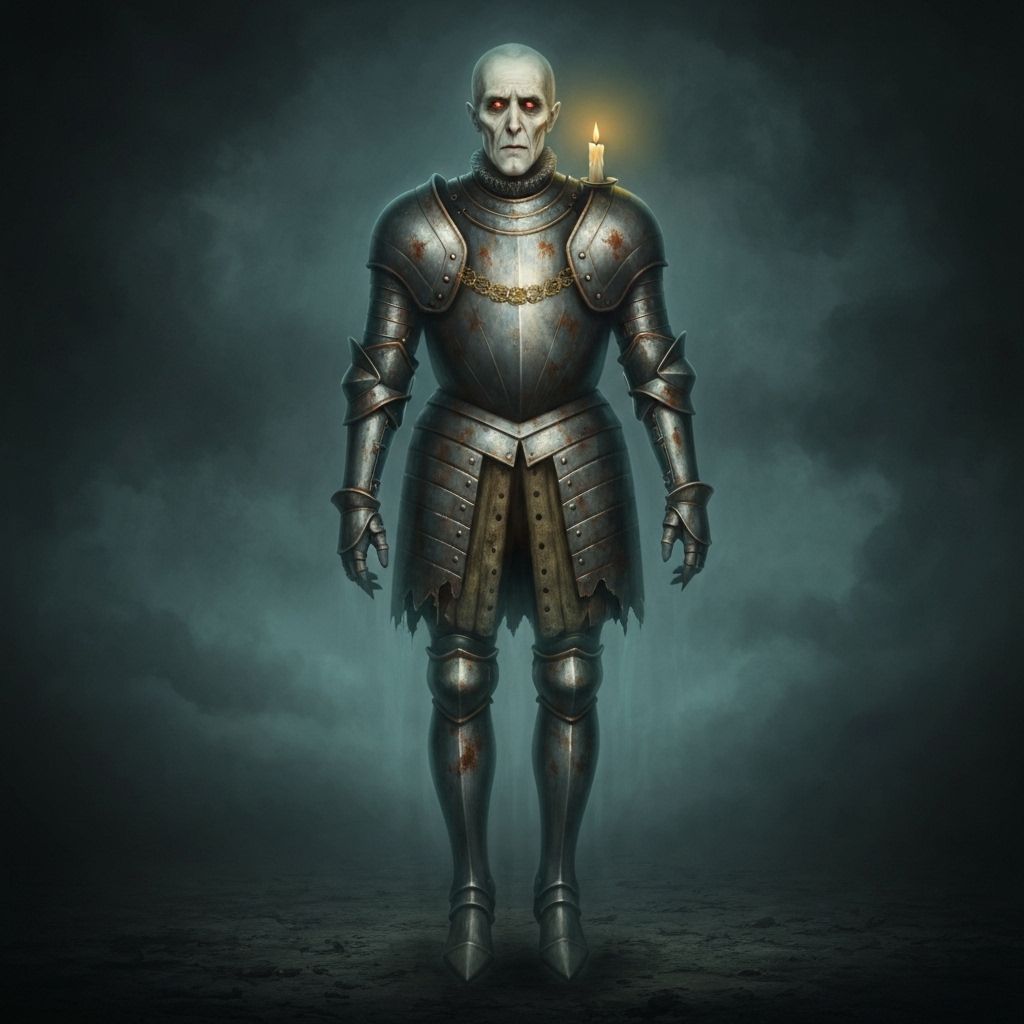
The Ghost
Spirit of Hamlet's FatherThe supernatural catalyst who reveals the truth of his murder and demands vengeance.
Ghost Character Analysis Summary
The Ghost serves as the supernatural force that sets the entire tragedy in motion. His appearance bridges the natural and supernatural worlds, representing the intrusion of the otherworldly into the political realm of Denmark. Without his revelation of murder and demand for revenge, there would be no play.
The Ghost's moral status remains deliberately ambiguous throughout the play. While he claims to be Hamlet's father seeking justice, Renaissance audiences would have questioned whether he might be a demon in disguise, sent to damn Hamlet's soul. This uncertainty reflects the play's broader themes about the difficulty of distinguishing truth from deception.
The Ghost represents the weight of history and tradition, demanding that past wrongs be avenged according to the old code of honor. His presence suggests that the past cannot be buried and that unresolved injustices will continue to haunt the present until they are addressed.
The Ghost's description of his torment in purgatory - 'confined to fast in fires' until his sins are purged - reflects Catholic theology about the afterlife. His suffering adds urgency to his demand for revenge, as he cannot rest until his murder is avenged and his spiritual account settled.
Despite his supernatural nature, the Ghost has significant limitations. He can only appear at night, cannot directly harm Claudius, and must rely on Hamlet to carry out his revenge. These constraints emphasize the separation between the spiritual and physical worlds and Hamlet's crucial role as the Ghost's earthly agent.
The Ghost functions as the ultimate paternal authority figure, placing an enormous burden of filial duty on Hamlet. His command to 'remember me' becomes both a blessing and a curse, binding Hamlet to a mission that will ultimately destroy him. The Ghost's love for his son is complicated by the destructive nature of his demands.
The Ghost's revelation exposes the corruption at the heart of the Danish state, suggesting that Claudius's rule is fundamentally illegitimate. His appearance represents the return of the rightful order, though his method of restoration - through violence and revenge - perpetuates the cycle of corruption and bloodshed.
As a dramatic device, the Ghost provides essential exposition while creating an atmosphere of supernatural dread. His appearances are carefully timed for maximum dramatic impact, and his presence transforms what might have been a political drama into a supernatural thriller that explores the boundaries between life and death.
The Ghost embodies the concept that murder will out and that justice, though delayed, will ultimately be served. His restless spirit represents all unavenged crimes and suggests that moral order, though temporarily disrupted, will eventually be restored - albeit at great cost to the living.
Famous Quotes & Analysis
"Remember me."
— Act I, Scene V
Analysis: This simple command becomes the driving force of the entire play. The imperative mood creates an inescapable obligation, while the brevity contrasts with the Ghost's earlier lengthy revelation, making these final words particularly haunting and memorable.
"Murder most foul, as in the best it is, but this most foul, strange, and unnatural."
— Act I, Scene V
Analysis: The Ghost's description emphasizes the exceptional nature of his murder through escalating adjectives. The phrase "murder most foul" has become iconic, while "unnatural" suggests a violation of both family bonds and cosmic order.
"I am thy father's spirit, doomed for a certain term to walk the night."
— Act I, Scene V
Analysis: This self-identification establishes the Ghost's authority while revealing his supernatural limitations. The phrase "doomed for a certain term" suggests both punishment and temporary nature, creating urgency for his mission of revenge.
"If thou didst ever thy dear father love— Revenge his foul and most unnatural murder."
— Act I, Scene V
Analysis: The Ghost manipulates filial love to compel revenge, creating an impossible moral dilemma for Hamlet. The conditional "if" challenges Hamlet's love while the imperative "revenge" demands action, establishing the central conflict of the play.
"But that I am forbid to tell the secrets of my prison house, I could a tale unfold whose lightest word would harrow up thy soul."
— Act I, Scene V
Analysis: This tantalizing reference to untold horrors creates dramatic tension through what is not revealed. The metaphor of "prison house" for purgatory and "harrow up thy soul" suggests agricultural imagery of tearing and breaking, emphasizing spiritual torment.