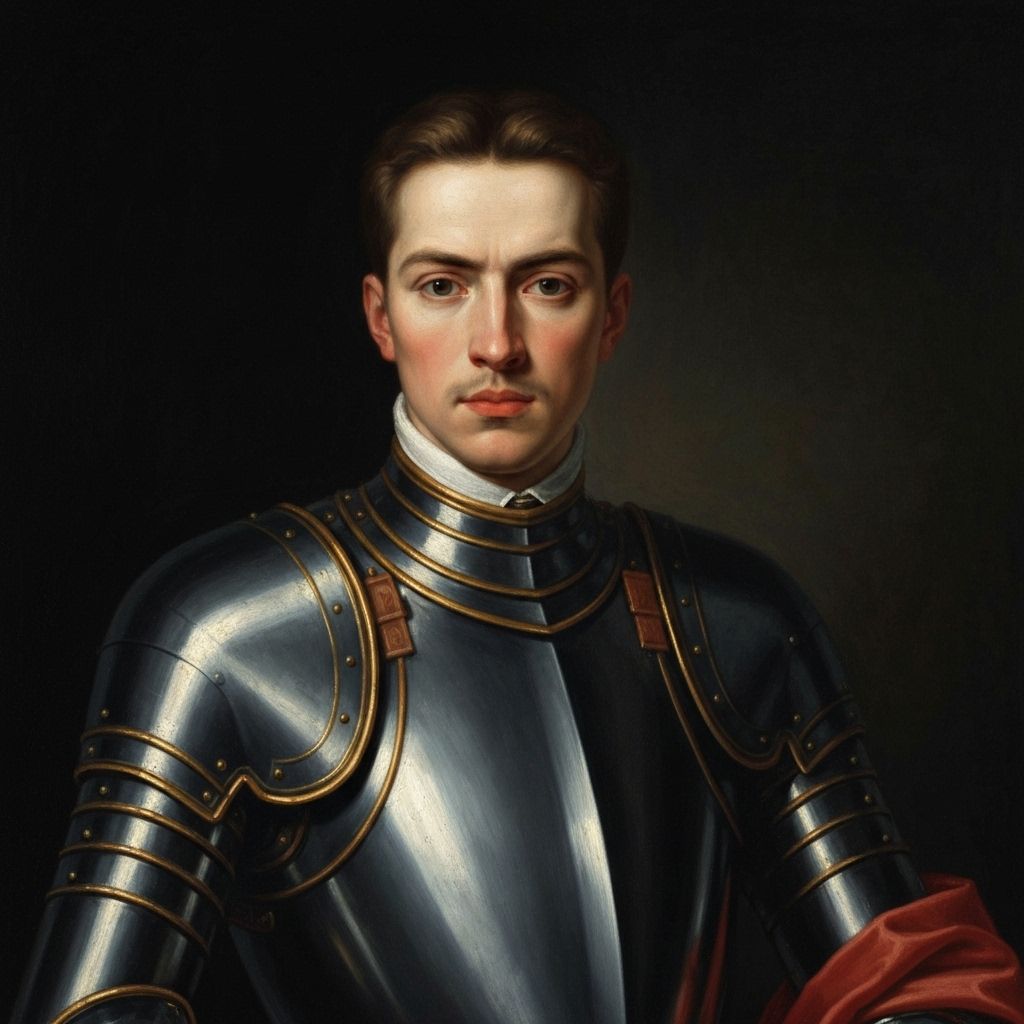
Fortinbras
Prince of NorwayThe decisive Norwegian prince who restores order to Denmark after the tragic conclusion.
Fortinbras Character Analysis Summary
Fortinbras serves as the ultimate foil to Hamlet, representing decisive military action in contrast to Hamlet's philosophical hesitation. Both are young princes seeking to avenge their fathers and reclaim lost honor, but where Hamlet delays and contemplates, Fortinbras acts swiftly and purposefully, embodying the Renaissance ideal of the active, martial prince.
Fortinbras represents the restoration of political stability and legitimate authority after the chaos and corruption that destroys the Danish court. His arrival at the play's end suggests that strong, decisive leadership can restore order from tragedy, though at the cost of Danish sovereignty passing to a foreign power.
Unlike Hamlet's complex moral reasoning, Fortinbras pursues honor through military conquest with single-minded determination. His willingness to fight over a worthless piece of Polish land demonstrates the Renaissance aristocratic code that values honor and reputation above practical considerations, providing a stark contrast to Hamlet's ethical deliberations.
Though Fortinbras appears only briefly in the play, his presence looms throughout as a political and military threat to Denmark. This structural choice emphasizes how external forces and the threat of war shape the internal politics of Elsinore, while his minimal stage time makes his final triumph more dramatically powerful.
Like Hamlet, Fortinbras seeks to avenge his father's death and restore his family's honor, but he pursues this goal through legitimate military and diplomatic channels rather than personal vengeance. This parallel highlights different approaches to filial duty and suggests that Fortinbras's more conventional path leads to success while Hamlet's introspective approach leads to destruction.
Fortinbras demonstrates shrewd political intelligence by accepting his uncle's diplomatic solution regarding Denmark, then redirecting his military ambitions toward Poland rather than Denmark. His ability to adapt his goals while maintaining his martial reputation shows political flexibility that contrasts with the rigid, self-destructive politics of the Danish court.
Fortinbras's assumption of the Danish throne at the play's end represents both restoration and conquest. His promise to honor Hamlet suggests continuity with the past, while his foreign origin signals a complete break with the corrupt Danish dynasty, offering hope for renewal through external intervention.
Fortinbras arrives at Elsinore to find the entire royal family dead, making him the ultimate witness to the consequences of revenge, corruption, and indecision. His role as observer and inheritor of the tragedy positions him to learn from Denmark's mistakes and potentially govern more wisely.
Fortinbras embodies the Renaissance military ideal - courage, decisiveness, and action - that Hamlet admires but cannot emulate. His success suggests that in the political world of the play, martial virtue and decisive action triumph over philosophical contemplation, though the play leaves ambiguous whether this represents progress or merely a different form of violence.
Famous Quotes & Analysis
"Go, captain, from me greet the Danish king. Tell him that by his license Fortinbras craves the conveyance of a promised march over his kingdom."
— Act IV, Scene IV
Analysis: This diplomatic request demonstrates Fortinbras's political acumen and respect for proper protocol. Unlike the scheming within the Danish court, Fortinbras conducts his military affairs through legitimate channels, showing his commitment to honorable action.
"Let four captains bear Hamlet like a soldier to the stage, for he was likely, had he been put on, to have proved most royal."
— Act V, Scene II
Analysis: Fortinbras's eulogy for Hamlet shows his respect for a fellow prince and warrior. His recognition of Hamlet's potential greatness and his order for military honors demonstrates both magnanimity in victory and understanding of princely virtue, establishing him as a worthy successor.
"This quarry cries on havoc. O proud Death, what feast is toward in thine eternal cell, that thou so many princes at a shot so bloodily hast struck?"
— Act V, Scene II
Analysis: Fortinbras's poetic response to the carnage at Elsinore reveals his capacity for eloquence and philosophical reflection. The personification of Death as hosting a feast shows his ability to comprehend tragedy on both practical and metaphysical levels, suggesting he possesses wisdom beyond mere military prowess.
"I have some rights of memory in this kingdom, which now to claim my vantage doth invite me."
— Act V, Scene II
Analysis: This assertion of legitimate claim to the Danish throne reveals Fortinbras's political awareness and his understanding of dynastic rights. His reference to "rights of memory" suggests historical claims while "vantage" acknowledges the opportunistic timing, showing his blend of legitimacy and pragmatism.
"Go, bid the soldiers shoot."
— Final line of the play, Act V, Scene II
Analysis: The play's final command is characteristically military and decisive, establishing Fortinbras's authority through action rather than words. The military salute for Hamlet transforms the tragic ending into a ceremonial moment, suggesting that order and martial discipline will replace the chaos and corruption of Claudius's reign.